
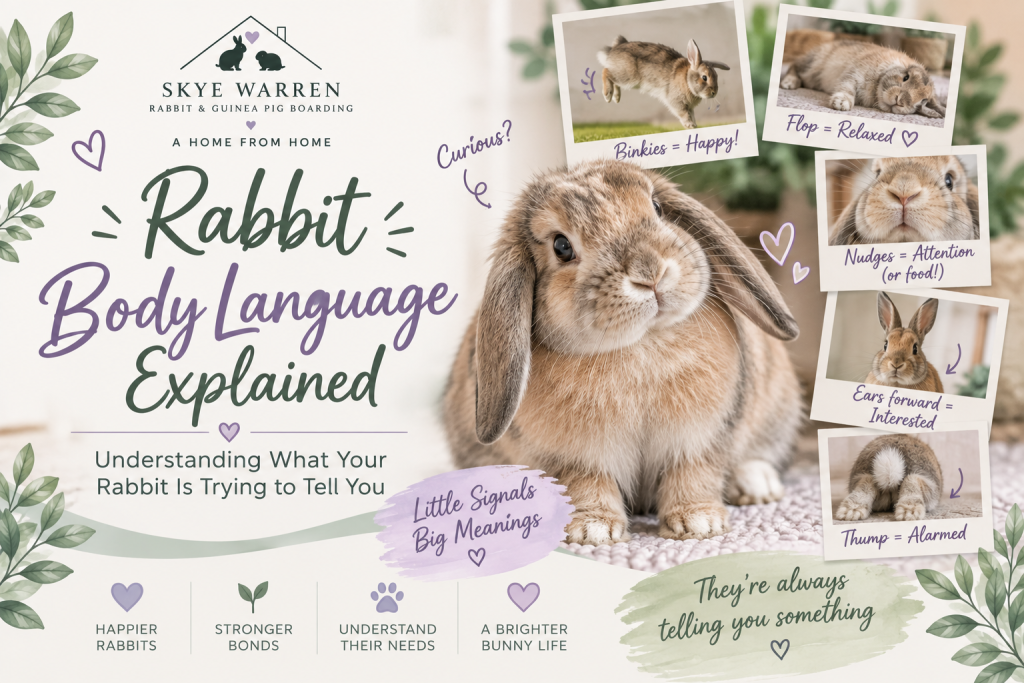
Rabbits may not be able to tell us exactly what they’re thinking, but that doesn’t mean they’re difficult to understand.
From a relaxed flop to an excited binky, a nose twitch to a thump, rabbits are constantly communicating through their body language, posture, movements and behaviour.
Learning what these signals mean can help you understand your rabbit’s personality, recognise when they’re happy and spot when something may be worrying them.
It can also make your relationship stronger. When you learn to listen to your rabbit’s body language, you can respond to what they are telling you rather than expecting them to communicate in the same way a dog or cat might.
So, what is your rabbit actually trying to tell you?
Let’s decode some of the most common rabbit behaviours.
Why Is Rabbit Body Language Important?
Rabbits are prey animals, so communication is incredibly important to them.
They use subtle changes in posture, movement and behaviour to communicate with other rabbits — and they can use many of these signals around people too.
Understanding those signals can help you recognise whether your rabbit is:
- Relaxed
- Happy
- Excited
- Curious
- Nervous
- Frightened
- Annoyed
- Seeking attention
- Feeling uncomfortable
Rather than looking at one behaviour in isolation, it’s best to consider the whole picture.
What is happening around your rabbit?
What is their body doing?
Are their ears relaxed or tense?
Are they eating normally?
Are they choosing to approach you or move away?
Your rabbit’s usual personality is important too.
A confident rabbit and a naturally nervous rabbit may react very differently to exactly the same situation.
Happy and Relaxed Rabbit Body Language
One of the loveliest parts of having rabbits is learning to recognise those moments when they’re completely content.
The Rabbit Flop
Few things are more dramatic than a rabbit suddenly throwing themselves onto their side.
It can look alarming the first time you see it!
A relaxed rabbit may flop onto their side or back and stretch out when they feel safe and comfortable.
You might see this after exercise, while they’re resting or when they’re simply enjoying a peaceful moment.
A flop can be a wonderful sign that your rabbit feels relaxed in their surroundings.
The Bunny Binky
A binky is one of the most recognisable signs of a happy rabbit.
Your rabbit may suddenly jump into the air, twist their body or flick their feet before landing and carrying on as though nothing happened.
Sometimes binkies are tiny.
Sometimes they’re spectacular.
And sometimes they happen for absolutely no apparent reason. 😂
Binkies are generally associated with excitement, happiness and playful energy.
If your rabbit suddenly starts throwing shapes around their accommodation, there’s a good chance they’re having a very good time.
Zoomies
Another brilliant sign of an energetic and happy rabbit is the classic rabbit zoomie.
Your rabbit may suddenly race around their space, dart through tunnels, change direction at lightning speed and generally behave as though they’ve got somewhere extremely important to be.
Zoomies are often followed by a dramatic flop.
Because apparently rabbits like to go from 100 mph to completely horizontal in approximately three seconds.
Stretching Out
A rabbit that stretches out comfortably is often showing that they feel safe enough to relax.
You might see their back legs stretched behind them or their body lying comfortably on the floor.
The more relaxed their posture, the more comfortable they may be feeling.
What Do Rabbit Ears Mean?
Rabbit ears can give you some useful clues about what your rabbit is paying attention to.
However, ear position isn’t always straightforward.
Some rabbits have naturally upright ears, while lop-eared rabbits have very different ear positions.
Your rabbit’s ears should therefore be considered alongside their overall body language.
Ears forward
Ears pointing forward can indicate that your rabbit is interested in something.
Perhaps they’ve heard a noise.
Maybe you’ve opened the vegetable drawer.
Or perhaps something fascinating has caught their attention.
Ears relaxed
Relaxed ears can accompany a relaxed rabbit, particularly when the rest of their body is loose and comfortable.
Ears back
Ears held back can mean different things depending on the situation.
Your rabbit might be relaxed, annoyed, frightened or simply positioning their ears differently.
Look at the rest of their body language before deciding what they’re communicating.
What Does It Mean When a Rabbit Nudges You?
That little nose bump can be surprisingly expressive.
Your rabbit may nudge your hand, leg or foot for several reasons.
They could be:
- Investigating you
- Asking for attention
- Asking you to move
- Looking for food
- Wanting you to stroke them
Context matters.
If your rabbit nudges your hand and then lowers their head, they may be asking for some attention.
If they repeatedly nudge you while you’re sitting somewhere they want to investigate, their message might be slightly more along the lines of:
“Excuse me. You’re in my way.” 😂
Why Does My Rabbit Lick Me?
If your rabbit licks your hand, arm or clothing, they may be displaying social or grooming behaviour.
Rabbits groom one another as part of their social relationships, so licking can be a lovely sign of affection and trust.
Some rabbits are enthusiastic groomers.
Others never lick their humans.
Both are perfectly normal.
A rabbit doesn’t need to lick you to have a strong bond with you.
Why Does My Rabbit Sit Beside Me?
Sometimes the simplest behaviours are the most meaningful.
If your rabbit chooses to sit beside you when they have the freedom to move elsewhere, they’re choosing to spend time near you.
They might not want to be touched.
They might not want to sit on your lap.
They may simply want to be near you.
For some rabbits, that is their version of affection.
This is particularly important to remember when bonding with a rabbit. Not every rabbit shows love through cuddles.
You can read more about building your relationship in our guide:
How to Bond With Your Rabbit: Building Trust and a Stronger Relationship
Rabbit Tooth Purring
Rabbits can make a quiet, gentle grinding or chattering sound with their teeth when they are relaxed and content.
This is sometimes described as tooth purring.
You may notice it while gently stroking a relaxed rabbit.
However, tooth grinding can also occur when a rabbit is experiencing pain, so context is extremely important.
A rabbit who is otherwise relaxed, eating normally and behaving as usual may simply be enjoying themselves.
A rabbit who is grinding their teeth loudly or persistently, particularly alongside changes in appetite, behaviour or posture, should be taken seriously.
If you’re concerned about your rabbit’s health, contact your vet for advice.
What Does a Rabbit Thump Mean?
A rabbit thumping their back foot can be quite startling.
Thumping is commonly associated with alarm or fear and is a way rabbits can communicate that something is wrong or that they have detected something concerning.
Your rabbit might thump because they:
- Heard an unfamiliar noise
- Saw something frightening
- Smelled something unfamiliar
- Feel threatened
- Are unhappy about something
Sometimes the reason will be obvious.
Other times you’ll be standing there wondering what on earth they’ve seen.
Rabbits can detect sounds and smells that we don’t notice, so their reaction may make more sense to them than it does to us.
If your rabbit thumps, don’t punish them.
Instead, look around and consider what might have caused the reaction.
Hiding: Is My Rabbit Scared?
Rabbits naturally enjoy having places where they can hide.
Having a safe hiding area isn’t a bad thing. In fact, providing suitable hiding spaces is an important part of good rabbit accommodation and enrichment.
However, a sudden increase in hiding can be worth paying attention to.
If your normally confident rabbit suddenly spends much more time hiding, consider whether something has changed.
It could be:
- A new noise
- A change in their environment
- A new animal nearby
- A stressful experience
- A change in their routine
- Illness or discomfort
Always consider your rabbit’s normal behaviour.
You know them better than anyone.
A Crouched or Tense Rabbit
A rabbit that is frightened or uncomfortable may appear tense or crouched.
They may stay very still, keep their body tight and appear ready to move quickly if necessary.
Their eyes may appear wide, and they may press themselves low to the ground.
If your rabbit looks frightened, give them space.
Don’t force them to interact with you.
Instead, remove or reduce whatever may be causing the stress where possible and allow them time to settle.
What Does It Mean When a Rabbit Runs Away From You?
It can be tempting to take this personally.
Your rabbit runs away and suddenly you’re thinking:
“After everything I’ve done for you?! I bought you the expensive hay!” 😂
But running away doesn’t necessarily mean your rabbit dislikes you.
They may be:
- Startled
- Busy exploring
- Wanting some space
- Unsure about what you’re doing
- Nervous about being picked up
- Simply in the mood to go somewhere else
If your rabbit regularly runs away when you approach, avoid chasing them.
Chasing can make them more nervous and can damage the trust you’re trying to build.
Instead, sit nearby and allow them to approach you when they’re ready.
Why Does My Rabbit Circle My Feet?
Some rabbits circle their owner’s feet, particularly when they’re excited.
This can sometimes be associated with attention, excitement or courtship-type behaviour.
You might notice it particularly around feeding time or when your rabbit is expecting something exciting.
Just be careful where you’re putting your feet!
Rabbits have a remarkable ability to appear directly underneath you approximately 0.2 seconds before you take a step.
What Does It Mean When a Rabbit Grunts?
A grunt, growl or similar vocalisation can indicate that your rabbit is unhappy or feeling defensive.
They may be telling you to back off.
You might notice this when:
- You reach into their space
- You try to move them
- They don’t want to be handled
- They’re protecting food or an area
- They’re frightened or irritated
Don’t punish your rabbit for communicating.
Instead, stop and consider why they are uncomfortable.
Respecting those signals helps your rabbit learn that you will listen when they communicate with you.
Rabbit Body Language During Handling
Handling is another area where understanding body language is extremely important.
A rabbit that becomes tense, struggles, kicks or repeatedly tries to escape is telling you that they are uncomfortable.
This doesn’t mean you can never handle them.
Some handling is necessary for health checks, grooming, nail care and veterinary treatment.
However, handling should be gentle, appropriate and as stress-free as possible.
Never pick a rabbit up simply because you want a cuddle if you already know they dislike being carried.
Many rabbits prefer interacting with their humans while all four feet remain firmly on the ground.
Changes in Body Language Can Be Important
One of the most important things to remember is that you know your rabbit’s normal behaviour.
A change in behaviour can sometimes be an early indication that something isn’t right.
Watch for changes such as:
- Becoming unusually quiet
- Hiding more than normal
- Reduced appetite
- Changes in toileting
- Sitting hunched or unusually still
- Becoming reluctant to move
- Suddenly becoming aggressive or defensive
- Changes in grooming
- A noticeable change in their normal routine
These signs don’t automatically mean your rabbit is unwell, but they shouldn’t simply be ignored.
Rabbits can be very good at hiding signs of illness, so if you’re concerned about a change in your rabbit’s behaviour or wellbeing, seek advice from your vet.
The Importance of Knowing Your Individual Rabbit
Perhaps the most important lesson when learning rabbit body language is that there isn’t a single universal dictionary.
Your rabbit has their own personality.
One rabbit might happily greet every person they meet.
Another might hide behind their favourite tunnel until they’ve decided someone is trustworthy.
One might demand attention by nudging your hand.
Another might simply sit beside you.
The more time you spend with your rabbit, the easier it becomes to recognise their individual signals.
You’ll begin to notice the difference between:
“I’m relaxed.”
“I’m interested.”
“I’m excited.”
“Please leave me alone.”
And, of course:
“WHERE ARE THE VEGETABLES?”
That understanding is one of the best parts of living with rabbits.
How Understanding Body Language Can Strengthen Your Bond
Learning your rabbit’s body language isn’t just about knowing whether they’re happy or frightened.
It’s about building trust.
When you respond appropriately to what your rabbit is telling you, they learn that you listen.
If they move away, you give them space.
If they approach, you allow them to investigate.
If they ask for attention, you respond positively.
If they’re frightened, you help them feel safe.
Over time, those repeated positive interactions can create a much stronger relationship.
And the more you understand your rabbit, the more you’ll appreciate just how expressive these little animals really are.
Final Thoughts
Rabbits may not speak our language, but they certainly have plenty to say.
From binkies and flops to thumps and nose nudges, their behaviour gives us clues about how they’re feeling and what they need.
The key is to look at the whole picture rather than focusing on one signal.
Learn your rabbit’s normal behaviour.
Pay attention to changes.
Respect their boundaries.
And most importantly, give them time to communicate with you in their own way.
Because once you start understanding rabbit body language, you realise that your bunny has probably been talking to you all along. 💜🐰
🐰 More Rabbit Care Advice
Want to understand your rabbit even better?
Take a look at our other rabbit care guides, including:
How to Bond With Your Rabbit: Building Trust and a Stronger Relationship
How to Tell if Your Rabbit Is Happy: 15 Signs of a Healthy, Content Bunny
Rabbit Enrichment: 15 Simple Ways to Keep Your Rabbit Happy
Preparing Your Rabbit for Boarding: The Complete Checklist
Or explore the Skye Warren Knowledge Hub for more rabbit and guinea pig care advice.